150,000 lumber dry kilns produce nearly 40 million tons(!) of carbon dioxide per year world wide. If all of these kilns would operate in an eco-friendly manner, owners could save a lot of money and the environment would benefit as well.
People often ease their conscience by saying, “With lumber, we are part of an environmentally friendly industry“. Or, ”We operate a wood boiler. The greenhouse gases it releases were previously bound during tree growth.” That´s all true, but people tend to forget about the energy that had to be supplied from outside sources for this cycle (boiler production, pelletization, transport, etc.).
Innovative drying technology for reduction of CO2 emissions
People often ease their conscience by saying, “With lumber, we are part of an environmentally friendly industry“. Or, ”We operate a wood boiler. The greenhouse gases it releases were previously bound during tree growth.” That´s all true, but people tend to forget about the energy that had to be supplied from outside sources for this cycle (boiler production, pelletization, transport, etc.).
And moreover, our shared climate problem is that more CO2 is being released than our “still” blue planet is able to absorb. We may only reduce this deficit in the overall ecological balance by either reducing emissions or increasing CO2 sinks (CO2 sinks absorb greenhouse gases, e.g., forests as carbon stores).
150,000 lumber dry kilns produce nearly 40 million tons (!) of carbon dioxide per year world wide. If all of these kilns would operate in an eco-friendly manner, owners could save a lot of money and the equivalent pollution of 3 million cars or 2.7 million households might be prevented each year.
Initiative HILDEBRAND
The HILDEBRAND initiative relies on enthusiasm and unconditional support for environmental protection from all stakeholders in the operating, research, and manufacturing sectors. And it is 100% guaranteed, as “green lumber drying” contributes to energy savings without the usual upfront investment with very long payback periods. From day one, your wallet and environmental conscience may consistently be relieved – through a 15–25 percent reduction in energy consumption and CO2 emissions.
The HILDEBRAND initiative helps governments achieve their ambitious energy and climate goals more easily. In addition, you may participate in European CO2 certificate trade and enjoy the associated benefits.
In conclusion: Green symbolizes hope. The new HILDEBRAND GREENKILNS® drying process.
The patented GreenKilns® process
1. Heating up with exhaust air
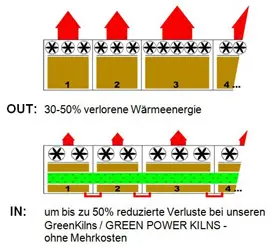
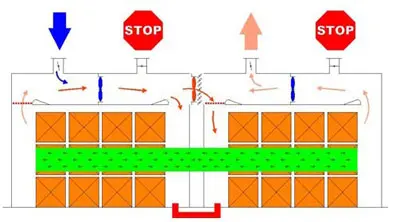
While heating up, the kiln needs heat as quickly as possible, but the lumber should not dry yet. In a conventional drying process, water is sprayed for this purpose, and this sprayed water must then be evaporated again using valuable thermal energy – but not so with the GreenKilns® process! With GreenKilns®, the warm, moist air that is normally blown outside through the exhaust air vents is reused by other dry kilns or drying zones. The valuable energy remains within the system for your benefit.
2. Conditioning with moisture extracted from lumber
The conditioning phase takes place after drying. It is supposed to ensure a homogenous final moisture distribution. During this phase, the drying process requires moist and warm air. With GreenKilns®, again there is no need for extra spraying because moisture is extracted from another kiln or drying zone.
3. Precious „stored heat“ during cool-down
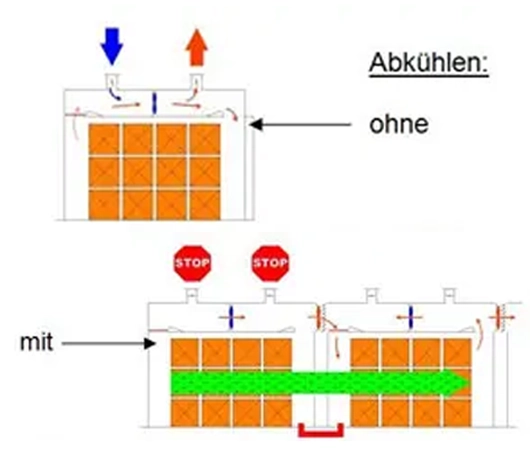
After conditioning, the cool-down starts to reduce lumber temperature to an uncritical level. The kiln and its lumber content resemble an „oven“. The precious stored heat contained in this „oven“ is guided to another kiln or drying zone by the GreenKilns® system. The hot air that is bound for the other kiln is then replaced with cold air from outside.
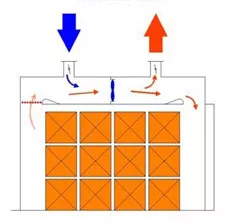
In conventional dry kilns, the precious stored heat is wastefully released to the surrounding area without any recuperation.